


When the Next Nor'easter Hits: Keeping a New Jersey Home Running Through a Winter Outage
If you lived through last February's blizzard, you remember the quiet. The furnace clicks off, the fridge goes silent, and the whole family starts refreshing the outage map every twenty minutes. Then the house starts to get cold.
Winter outages in New Jersey aren't a once-in-a-decade event anymore. Last winter brought two major storms in two months. This winter, forecasters are watching one of the strongest El Niño patterns on record, a setup that tends to send more coastal storms up the Mid-Atlantic. At the same time, the regional power grid is heading into the season with less breathing room than it's had in years.
This guide walks through what forecasters and grid operators are predicting for winter 2026–27, how often New Jersey homes actually lose power and for how long, and what it takes to keep your heat, water and food safe when the lines come down. We've noted our sources throughout and listed them at the end, so you can check the numbers yourself.
Last winter was a warning
The February 2026 blizzard, which PSEG called Winter Storm Hernando, buried parts of New Jersey under two to three feet of snow. Wind gusts near 50 mph snapped branches and toppled trees onto power lines across the state. At the peak, Governor Mikie Sherrill reported 365,000 outages, more than any weather event the state had seen in recent years. The Jersey Shore and South Jersey took the worst of it. Some households in Atlantic and Camden counties were still without power on day three.
It wasn't the only storm. A month earlier, a January storm pushed the governor to declare a State of Emergency in all 21 counties. Around the same time, Winter Storm Fern brought the longest stretch of extreme cold the regional grid had faced since the 1990s, with demand above 130,000 megawatts for eight straight days.
History shows how bad it can get. The last time New Jersey saw outages above 300,000, during the March 2018 nor'easters, it took 11 days to get everyone back online.
Utility crews do hard, dangerous work in these storms, and they restore most customers within a day or two. But restoration follows a set order. Crews fix transmission lines and substations first, then main distribution lines, then side streets, and finally individual homes. If your house sits at the end of a long rural line or a tree-lined street, you may be among the last to get power back, even after the news says "90% restored."
What forecasters are predicting for winter 2026–27
No one can tell you in November exactly how many storms will hit New Jersey this winter. Snowstorms can only be forecast reliably about a week out. But seasonal outlooks and grid reports tell us a lot about the risk. Here's what the major forecasters are saying.
NOAA: warmer and wetter, with a very strong El Niño
NOAA's official Winter Outlook, released October 16, 2026, covers December through February. It leans toward warmer-than-average temperatures for much of the East and wetter-than-average conditions along the East Coast. Behind that outlook is El Niño. NOAA's Climate Prediction Center puts the chance of a very strong El Niño this winter at over 90%.
"Warmer" might sound like good news, but it isn't when it comes to power lines. Winters that hover near freezing produce the storms that do the most damage to the grid: heavy, wet snow, freezing rain and ice. Wet snow weighs far more than dry powder, and ice coats branches and lines until they snap. A storm that is a few degrees colder drops fluffy snow that utilities can handle. A storm right at 32°F brings trees down.
El Niño and nor'easters
El Niño shifts the jet stream and strengthens the storm track across the southern U.S. and up the East Coast. Climate researchers at Cornell's Northeast Regional Climate Center note that storms often move up the coast during El Niño winters, bringing above-normal precipitation to the Eastern Seaboard. New Jersey climatologists have long pointed out that nor'easters tend to be more common in El Niño winters. Past strong El Niño winters back that up: winter 2009–10 brought repeated February snowstorms, and the 2015–16 El Niño produced the January 2016 blizzard.
That doesn't guarantee a stormy winter. Each El Niño plays out differently, and other patterns can override it. But the odds of coastal storms are tilted upward this year.
Farmers' Almanac: a "tricky" winter for the Northeast
The Farmers' Almanac, which uses its own long-standing formula rather than computer models, calls for the Northeast to face "one of the season's most complicated winter patterns." It predicts coastal areas will see more rain and mixed precipitation, while inland areas get several rounds of heavy, wet snow, especially in January and February. Take any long-range almanac forecast with a grain of salt. Still, it lines up with NOAA's picture: a mild, wet winter with a lot of messy storms near the freezing line.
NERC: enough power for a normal winter, risk in an extreme one
The North American Electric Reliability Corporation (NERC) published its 2026–2027 Winter Reliability Assessment on November 18. The good news: new resources, delayed plant retirements and better cold-weather performance have improved the outlook, and every region has enough supply for a normal winter peak. The caution: extreme, wide-area cold could still lead to supply shortfalls. NERC also flagged that this year's El Niño adds unpredictability. Based on what happened in January 2026, it told grid operators to plan for extreme conditions lasting 10 days or more.
PJM: a possible new winter record
PJM runs the regional grid that serves New Jersey and 12 other states plus Washington, D.C. Its winter outlook, released November 5, forecasts a peak of about 147,500 megawatts. That would beat PJM's all-time winter record of 143,700 megawatts, set in January 2025. PJM expects enough generation to meet that demand, but it says reserve margins keep tightening as demand grows faster than new power plants come online. One sign of the strain: PJM called on demand response, paying large customers to cut usage at peak times, 15 times in 2025 and 2026, compared with eight times in the previous eight years.
What it adds up to
Put together, the forecasts point to a winter with:
More storms than usual near the freezing line, the kind that bring heavy, wet snow and ice down on trees and power lines.
Coastal and South Jersey homes most exposed to wind and mixed precipitation, as they were last February.
A grid that should be fine on a normal cold day, but with less cushion if a long cold snap arrives.
For most New Jersey families, the bigger risk isn't a statewide blackout. It's a local outage after a storm, when your street waits its turn for a repair crew.
How many outages should you expect, and how long will they last?
Forecasters don't predict outage counts for individual homes. What we do have is a long record of how often New Jersey customers lose power and how long it takes to get it back. That history, combined with this winter's outlook, gives a realistic planning picture.
The averages look small. According to the U.S. Energy Information Administration (EIA), the average New Jersey electric customer lost power for about 2.9 hours in 2024 and about 2.6 hours in 2025, counting major storms. The typical customer had about one outage a year.
The averages hide the bad years. In 2020, when Tropical Storm Isaias hit, New Jersey customers averaged 15.7 hours without power. Nationwide, EIA found that customers averaged 11 hours without power in 2024, almost twice the average of the decade before, driven mostly by major storms. The 2026 blizzards aren't in those numbers yet. EIA publishes each year's figures the following fall.
Averages also hide where you live. An average of two or three hours means many customers lost power for only minutes, while others lost it for days. Homes at the Shore, in wooded areas and at the end of long rural lines wait the longest.
Nor'easters are a regular part of New Jersey winters. The state's hazard mitigation plan estimates New Jersey can be affected by 10 to 20 nor'easters a year, with five to 10 of them having a significant impact.
A planning guide for your household
Here's how we suggest New Jersey homeowners think about outage risk this winter. These are our planning estimates, not a forecast.
Outage type | How often | How long it typically lasts | What it takes to ride it out |
Short local outage (equipment, a car hits a pole) | About once a year for a typical customer | Minutes to a few hours | A small battery or UPS for internet and devices |
Storm outage on your street | Likely at least once in a stormy winter, especially near the Shore or in wooded areas | Overnight to 2 days | Battery backup for heat, sump pump, fridge and essentials |
Major storm outage (like Feb 2026 or March 2018) | Every few years, more likely in an active El Niño winter | 3 days to more than a week for the hardest-hit areas | Larger battery system, solar recharging, or a generator |
If you remember one thing from this section: plan for at least a two-day outage, and plan for longer if you live near the coast, on a well, or at the end of a long line.
What a winter outage actually shuts off
Many homeowners assume gas heat keeps working when the power goes out. Usually, it doesn't. Most gas furnaces need electricity for the blower motor, igniter, inducer fan and controls. Boilers need power for their circulator pumps and controls. Even a gas fireplace with an electric ignition or blower may not work. When the power goes, the heat usually goes with it.
Here's what typically stops in a New Jersey home:
Heat: furnace blowers, boiler pumps, thermostats and heat pumps
Sump pump: often at the worst time, with snowmelt and rain soaking the ground around your foundation
Well pump: no running water, and no flushing, if you're on a well
Refrigerator and freezer: hundreds of dollars of food on the clock, and medications that need to stay cold
Internet, phones and Wi-Fi: remote work, school and storm updates all depend on them
Medical devices: CPAP machines, oxygen concentrators and home medical equipment
Garage doors and security systems: stuck doors and dark cameras
EV charging: if you drive electric, your car is your way out of town, and it needs to be charged
The cold makes all of this more urgent. On a freezing night, a house can lose several degrees an hour once the heat stops. After a day or two, pipes in exterior walls and crawl spaces start to be at risk of freezing and bursting. A burst pipe can turn a power outage into a five-figure insurance claim.
How a home battery handles it
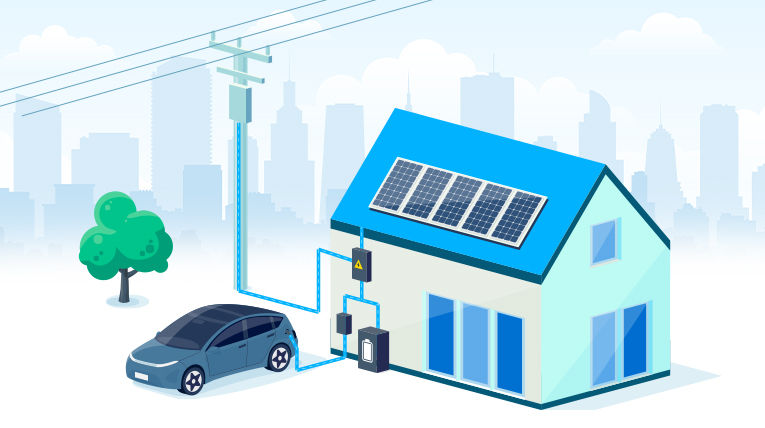
A home battery system, like the Tesla Powerwall 3, mounts on a wall or the floor, indoors or out. It stays charged from the grid, or from your solar panels if you have them. When the grid goes down, the system detects the outage and switches your home to battery power automatically. In most cases the lights don't even flicker. There are no pull cords, no fuel runs and no extension cords through a window.
Here are the specs that matter most for a New Jersey winter:
Energy: each Powerwall 3 stores 13.5 kWh. You can add Expansion Units, each with another 13.5 kWh, to last through longer outages.
Power: a Powerwall 3 delivers up to 11.5 kW of continuous output. That's enough to run a furnace blower, sump pump, refrigerator, lights and outlets at the same time in most homes.
Cold-weather rating: Tesla rates the Powerwall 3 to operate from –4°F to 122°F. Each battery cell has its own built-in heater. Tesla calls this Heat Mode: the battery keeps its cells warm enough to charge and discharge on the coldest nights. It's why we install Powerwalls outdoors in New Jersey all the time.
Smart storm prep: with Storm Watch turned on, the Tesla app watches weather alerts and charges the battery to full ahead of a severe storm, so you head into the outage with a full tank.
Power vs. energy
The point that trips most people up is the difference between power and energy.
Power (kilowatts, kW) is how much you can run at the same time. Think of it as the width of the pipe.
Energy (kilowatt-hours, kWh) is how long you can keep running. Think of it as the size of the tank.
A single Powerwall 3 has enough power for almost any home's essentials. If you want to ride out a multi-day outage, the question is energy, and that's what Expansion Units add. Adding more units doesn't let you run more at once. It lets you run the same things for longer.
How much backup do you need?
The best backup systems start with what you need to keep running, not with a product. When we design a system, we start with three questions:
Which circuits matter in an outage? For most families that's heat, the sump pump, the fridge, lights, outlets for phones and internet, and the well pump if there is one.
How long do you want to last? Riding out one night is very different from riding out three days.
Do you have solar, or want it? Solar can recharge a battery during the day, even in winter, which stretches your backup much further.
Rough winter energy use for essentials
These are typical ranges for a New Jersey home on a cold winter day. Your actual usage will vary with your home, your equipment and the weather.
Load | Typical draw while running | Typical energy per winter day |
Gas furnace blower and controls | 300–800 W | 4–8 kWh |
Refrigerator | 100–200 W | 1.5–2 kWh |
Sump pump (runs on and off) | 800–1,000 W | 0.5–3 kWh |
Well pump (runs on and off) | 1,000–2,000 W | 1–3 kWh |
LED lights, Wi-Fi, phones, TV | 100–300 W | 1.5–3 kWh |
CPAP or small medical device | 30–60 W | 0.3–0.6 kWh |
Add up the essentials and most homes with gas heat land somewhere around 10 to 15 kWh a day in cold weather. Here's what that means for battery sizing:
System | Storage | Essentials backup on a cold day (rough estimate) |
1 Powerwall 3 | 13.5 kWh | About 1 day |
1 Powerwall 3 + 1 Expansion Unit | 27 kWh | About 2 days |
1 Powerwall 3 + 2 Expansion Units | 40.5 kWh | About 3 days |
Any of the above + solar | Recharges on sunny days | Can stretch much longer |
You can also stretch any system by being smart during an outage. Turn the thermostat down a few degrees, skip the electric dryer and oven, and run big loads like the dishwasher only when the battery is full or the sun is out.
A word about electric heat
Electric baseboard heaters, electric furnaces and the backup heat strips in some heat pumps draw a lot of power, often 5 to 15 kW or more. They can be backed up, but they drain a battery quickly. A modern cold-climate heat pump is far more efficient, but in a deep cold snap it can still use 20 to 40 kWh a day or more. If electric heat is how your home stays warm, we'll walk you through the honest options: more storage, solar, a generator, or a combination.
Battery or generator?
We install both batteries and generators, so we don't have a stake in which one you choose. Here's an honest comparison (we go deeper in our battery vs. generator guide):
Home battery | Standby generator | |
Switchover | Automatic, near-instant | Automatic, usually takes several seconds |
Fuel | None; recharges from the grid or solar | Natural gas or propane |
Noise | Silent | Noticeable, similar to a lawnmower |
Exhaust | None | Must be placed away from windows and doors |
Maintenance | Minimal | Regular service and weekly exercise cycles |
Runtime | Limited by storage; extended by solar | As long as fuel lasts |
Everyday value | Can lower bills and qualify for utility programs | Only useful during outages |
If you need to run a whole house with electric heat through a week-long outage, a standby generator, or a battery paired with a generator, may be the right call. For most homes that want quiet, automatic backup of the things that matter, a battery is the better fit.
One more note on portable generators: every winter, people are hurt or killed by carbon monoxide from generators run in garages, basements or too close to the house. If you use one, keep it outside and well away from windows and doors, and make sure you have working carbon monoxide detectors.
Getting your home outage-ready this winter
A battery is the biggest step, but it's not the only one. Whether or not you install backup power, here's a short checklist for this winter:
Know your utility's outage map and save its outage reporting number in your phone: PSE&G, JCP&L or Atlantic City Electric.
Test your sump pump before the first big thaw, and consider a battery backup pump if you don't have whole-home backup.
Find your main water shutoff in case a pipe freezes and bursts.
Check smoke and carbon monoxide detectors, and replace batteries.
Keep phones, power banks and flashlights charged when a storm is in the forecast.
Charge your EV to a higher level than usual before a storm. Some Teslas can even power your home in an outage.
Make a plan for medications and medical devices that need power or refrigeration.
Know who you'll check on, like older neighbors or family who live alone.
Frequently asked questions
Will a battery keep my house warm if I have gas heat?
Yes, in most homes. Gas furnaces and boilers only need a small amount of electricity to run their blowers, pumps and controls. A battery handles that easily, so your gas heat keeps working through the outage.
Can a Powerwall be installed outside in a New Jersey winter?
Yes. Powerwall 3 is rated for outdoor installation and operates down to –4°F, with built-in cell heating for cold weather. We regularly install them on exterior walls when there isn't a good spot inside.
How long does installation take?
The install itself usually takes a day or two. Before that, there's a site assessment, design, a township permit and utility approval. That paperwork is why it's worth starting well before a storm is in the forecast.
Will the battery charge back up during a long outage?
Only if you have solar. Without solar, the battery runs until it's empty and then recharges when grid power returns. With solar, the panels can refill the battery on sunny days, even in winter, though snow-covered panels produce little until they clear.
Do I need to back up my whole house?
Usually not. Most families back up a chosen set of essential circuits: heat, the sump pump, the fridge, lights, outlets and internet. That keeps the system affordable and makes the stored energy last longer. Whole-home backup is an option if you want it.
What happens when the power comes back on?
The system reconnects to the grid automatically and starts recharging. You don't have to flip any switches.
Don't wait for the forecast
When a big storm shows up on the 7-day forecast, it's too late to install backup power. Battery installs need a site visit, a permit and utility approval, and demand jumps after every major outage. The best time to plan is now, before the heart of winter in January and February, when forecasters expect the messiest storms.
Ready to see what a winter backup system would look like for your home? Fill out our quick backup battery intake form or call us at 888-428-3880. Send us a photo of your electrical panel and tell us what you want to keep running, and we'll design a system around your home, not a sales pitch.
PowerSourceEV is a certified installer for battery suppliers that meet every home's needs, including Tesla Powerwall, Enphase IQ 10, GM PowerHub and EcoFlow OCEAN Pro, serving New Jersey and New York with home battery backup, EV chargers and generators. Call us at (888) 428-3880 or visit powersourceev.com to book a virtual appointment with one of our specialists.
Sources
NOAA 2026–2027 U.S. Winter Outlook (released Oct. 16, 2026) and NOAA Climate Prediction Center seasonal discussion on El Niño strength
NERC 2026–2027 Winter Reliability Assessment coverage, American Public Power Association (Nov. 18, 2026)
PJM Winter Outlook news release (Nov. 5, 2026) and Renewable Energy World coverage
Northeast Regional Climate Center, El Niño impacts for the Northeast
EIA Electric Power Annual, reliability metrics by state and EIA: outages in 2024
NJBIZ: Sherrill updates NJ on blizzard recovery (Feb. 24, 2026) and 6abc on the 2018 restoration timeline
PSEG: Record Storm. Jersey Ready Response. (Feb. 26, 2026)
Tesla Powerwall 3 specifications and Powerwall 3 Heat Mode white paper


Comments