


Solar + Battery Backup: How to Get Off the Grid in 2026

The lights flicker, the fridge goes quiet, and your phone shows an outage map covering half the county. For most homeowners, that is the moment the idea of energy independence stops being abstract. Add electricity rates that keep climbing year after year, and it is easy to see why more families are asking the same question: can solar and battery backup actually get me off the grid?
The short answer is yes, with the right design. A properly sized solar array paired with a modern home battery can run your house through outages, slash the power you buy from the utility, and in some cases let you disconnect entirely. Add a bidirectional EV charger, and the car in your driveway becomes the biggest battery you own.
In this guide, the PowersourceEV team breaks down how solar and battery storage work together, how to size a system, and what separates the three platforms we install most: the Tesla Powerwall 3, the EcoFlow OCEAN Pro and the Enphase IQ Battery 10C. We also explain vehicle-to-home (V2H) and vehicle-to-grid (V2G) charging, what the 2026 incentive landscape really looks like, and a practical roadmap from your first quote to true energy independence.
Whether you want rock-solid backup for the next storm or you dream of cutting the cord completely, this is where to start.
What Does "Going Off the Grid" Really Mean?
"Off the grid" gets used loosely, so it helps to separate three different goals. Each one needs a different system design and budget.
1. Backup power (grid-tied with storage)
Your home stays connected to the utility, but a battery automatically takes over when the grid fails. Most homeowners start here. You get outage protection, and when you add solar, you also lower your monthly bill.
2. Grid independence (grid-tied, self-powered)
Your home still has a utility connection, but solar and batteries supply most or nearly all of your daily energy. The grid becomes a safety net for long stretches of cloudy weather, not your main source of power. For most families, this is the sweet spot: you capture most of the savings and resilience of off-grid living without giving up the backstop.
3. Fully off-grid (no utility connection)
The meter is gone. Every kilowatt-hour you use must come from your own solar, batteries, a generator or a vehicle. True off-grid living is absolutely possible, but it demands a much larger system. You must size for the worst week of winter, not the average day, and you need a plan for long cloudy stretches, typically a generator or an EV with vehicle-to-home capability.
Why most homeowners choose grid independence
In the Northeast, a fully off-grid home usually needs two to three times the battery capacity of a grid-tied home with the same usage. December and January solar production can drop to a fraction of summer output. Some municipalities and lenders also expect an occupied home to keep a utility connection, so check local rules before you plan to disconnect.
That is why we usually recommend designing for grid independence first. You size the system to cover 80 to 100 percent of your annual energy and to carry your essential loads through multi-day outages. Then you decide later whether cutting the cord entirely makes financial sense. The good news is that every platform in this guide can grow with you.
Which Homes Can Get 100% Off the Grid, and Which Can't?
Not every home can realistically get 100 percent of its power from solar and batteries. Whether yours can comes down to five things: how much energy you use, how much sun you can capture, how much battery you can safely install, what your local rules allow, and how you heat the house.
Home type | Can it go 100% off grid? | Why |
Detached single-family home with a large south- or west-facing roof and little shade | Often yes | Enough roof space for an oversized array, room for a large battery bank in a garage or outdoors, and full control over the property |
Rural home or property with land for a ground-mount array | Very good candidate | A ground-mount array can be sized and angled for winter sun, and there is space for batteries and a backup generator |
All-electric home with a heat pump, EV and electric range | Possible, but expensive | Winter heating and EV charging can double daily usage just when solar production is lowest |
Home heated by natural gas or propane | Easier on the electric side | Heating load stays off the battery, though the home still depends on a fuel supply |
Home with a heavily shaded or small, complex roof | Usually no | The array cannot produce enough, especially in winter; grid independence for part of the year is more realistic |
Townhouse or condo | Rarely | Shared roofs, HOA approval, limited space for batteries and shared electrical service make full disconnection impractical |
Older home with a 100 A electrical service | Not without upgrades | A service or panel upgrade is often needed before a large solar and battery system can be connected |
Why some homes fall short
Winter sun. In New Jersey and New York, a December day can produce a fraction of a June day. A home that runs on solar in summer may need several times more battery capacity, or a backup source, to get through a cloudy week in January.
Roof and land space. Going fully off grid usually means an array 30 to 50 percent larger than a typical grid-tied system. Many suburban roofs simply do not have the room once you subtract chimneys, vents, skylights and shaded areas.
Battery placement and fire codes. Building and fire codes limit how much battery capacity can be installed in certain locations, such as inside living spaces. Homes with a garage, a basement with proper clearance or outdoor wall space have far more flexibility.
Local rules and lenders. Some municipalities expect an occupied home to keep a utility connection, and some mortgage lenders and insurers ask about it too. Check before you plan to remove your meter.
Heating. Electric heat is the single biggest swing factor. A gas-heated home might use 25 kWh a day in winter, while the same home with electric resistance heat can use two or three times that.
The realistic goal for most homes
If your home is not a strong candidate for 100 percent off grid, you can still get very close. A well-designed solar and battery system can cover most of your annual energy, run your home through multi-day outages, and cut your utility bill to a fraction of what it is today. The grid becomes a backup you rarely touch, and a site visit will tell you exactly how close your home can get.
How Solar and Battery Storage Work Together
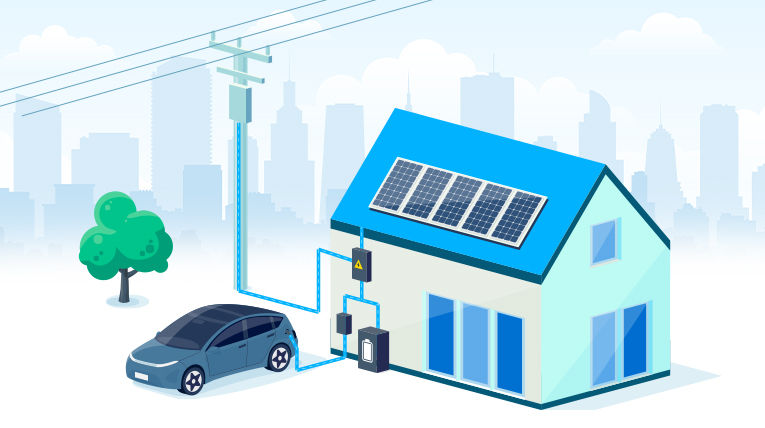
Solar panels alone cannot keep your lights on during a blackout. Standard grid-tied solar shuts down when the utility goes down, a safety rule that protects line workers. A battery changes that. It lets your home form its own "microgrid," so your panels keep producing and your house keeps running.
Here is what a typical day looks like in a solar-plus-storage home:
Morning: Panels start producing. The home uses solar first, and any surplus begins charging the battery.
Midday: Production peaks. The battery fills up, and once it is full, extra solar flows to the grid (where net metering or export credits apply).
Evening: The sun sets, but demand rises as cooking, laundry and air conditioning kick in. The battery discharges to cover your home instead of buying expensive peak-hour power.
Overnight: The battery carries base loads like the fridge, Wi-Fi and HVAC until morning, when the cycle repeats.
During an outage
When the grid fails, a gateway or smart panel isolates your home from the utility in a fraction of a second. Your battery becomes the power source, and your solar panels recharge it during the day. With enough solar and storage, this cycle can continue indefinitely, which is the essence of off-grid living.
Power vs. energy: the two numbers that matter
Every battery spec sheet lists two key ratings, and confusing them is the most common sizing mistake:
Energy (kWh) is the size of the tank. It determines how long you can run your home.
Power (kW) is the size of the pipe. It determines how many things you can run at once, and whether the battery can start a large motor like a central AC compressor or well pump.
How Much Solar and Battery Do You Need to Go Off Grid?
Sizing starts with your utility bills, not with a product catalog. Pull 12 months of usage and look at three things.
Step 1: Find your daily energy use
Divide your annual kWh by 365. Many homes use around 25 to 35 kWh per day on average, but homes with electric heat, a pool or an EV can easily use 50 kWh or more. Winter and summer peaks matter more than the average when you are planning for independence.
Step 2: Decide what you need to back up
Essential loads: refrigerator, lights, Wi-Fi, sump pump, furnace blower, medical devices. Often 8 to 15 kWh per day.
Whole-home backup: everything above plus central AC, electric range, dryer and well pump. This drives both power (kW) and energy (kWh) requirements up.
Off-grid: whole-home loads, every day, through the darkest weeks of the year.
Step 3: Size the solar array
A common rule of thumb is to divide your annual usage by roughly 1,200 to 1,300 kWh per installed kW in the Northeast. A home using 10,000 kWh a year typically needs an 8 to 9 kW array to offset its usage on paper. Going fully off-grid usually means oversizing the array by 30 to 50 percent so winter production can still refill the batteries.
Step 4: Size the battery
Goal | Typical storage | Example configuration |
Essential-load backup | 10 to 15 kWh | 1 Powerwall 3, 1 Enphase IQ Battery 10C, or 1 to 2 OCEAN Pro batteries |
Whole-home backup | 20 to 40 kWh | Powerwall 3 + Expansion units, 2 to 4 IQ Battery 10C, or 2 to 4 OCEAN Pro batteries |
Grid independence or off-grid | 40 to 80+ kWh, plus a backup source | Multiple Powerwalls, a large OCEAN Pro stack, or storage paired with a V2H-capable EV or generator |
Step 5: Check your surge loads
Central AC units, well pumps and heat pumps draw a burst of current when they start, measured as locked rotor amps (LRA). Your battery must handle that surge or the system will trip. This is where battery choice matters most, and it is one of the biggest differences between the three platforms below.
A professional load calculation and site visit will refine all of these numbers. Our team also checks your electrical panel, available breaker space and the distance between your panel, meter and battery location before we finalize a design.
Tesla Powerwall 3: The All-in-One Whole-Home Battery
The Tesla Powerwall 3 is the most recognized home battery in America, and for good reason. It combines a 13.5 kWh battery, a solar inverter and a system controller in one wall-mounted unit, which simplifies installation and reduces the number of boxes on your wall.
Key specs
Energy: 13.5 kWh usable per unit
Power: 11.5 kW continuous, enough to run most homes, including central AC, from a single unit
Solar input: up to 20 kW DC across 6 MPPT inputs, so it handles large and complex rooftop arrays
Expansion: up to three Powerwall 3 Expansion units per Powerwall 3, each adding 13.5 kWh, for 54 kWh behind one inverter
Off-grid boost: in qualifying installs, Tesla's install manual allows up to 15.4 kW of off-grid continuous output with an 80 A breaker and properly sized conductors
Warranty: 10 years
Why it works for going off grid
The built-in inverter means a new solar array can connect directly to the Powerwall 3, with no separate string inverter. That is a cleaner, more efficient path for DC solar to reach your battery. The 11.5 kW of continuous power is enough to start and run most central air systems, which is the load that trips smaller batteries.
Capacity scales in two ways. Expansion units add energy (runtime) because they share the main unit's inverter. Additional Powerwall 3 units add both energy and power, for larger homes or heavy simultaneous loads. In practice, if your peak load never approaches 11.5 kW, Expansion units are usually the better fit.
Smart features
The Tesla app shows production, consumption and battery level in real time. Storm Watch automatically charges the battery to full when severe weather is forecast. In many utility territories, Powerwall owners can also join virtual power plant (VPP) programs that pay for sharing stored energy during grid emergencies.
Best for: homeowners who want a proven, all-in-one system with strong surge power, a polished app, and a path to using a Tesla vehicle as backup.
EcoFlow OCEAN Pro: Maximum Power and Capacity for Large Homes
The EcoFlow OCEAN Pro is built for homeowners who want to run everything at once. It is a modular whole-home system made up of a hybrid inverter, stackable LFP batteries, a smart electrical panel and an optional EV charger, all managed from one app. If your home has multiple HVAC units, a pool or a large solar array, the OCEAN Pro deserves a serious look.
Key specs
Power: 24 kW continuous output from one hybrid inverter, with surge capability up to 50 kW
Motor starting: 205 A LRA, enough to start large AC compressors and well pumps
Energy: 10 kWh per battery, expandable to 80 kWh with up to eight batteries per inverter
Solar input: up to 40 kW of PV through 8 MPPT channels
Coupling: works with both new DC solar and existing AC-coupled solar
Chemistry: lithium iron phosphate (LFP), with integrated fire suppression and thermal management
Why it works for going off grid
Two things make the OCEAN Pro stand out for energy independence. First, its 24 kW of continuous power is roughly double what most single-inverter home batteries deliver. EcoFlow says that is enough to run up to two 5-ton HVAC systems, EV chargers and pool pumps at the same time. Second, its 40 kW of solar input lets you install the oversized array that true off-grid living requires, without adding a second inverter.
The OCEAN Pro is also a multi-source system. It can automatically pull energy from solar, batteries, the grid and even a gasoline generator. That generator integration is valuable for off-grid homes, because it covers the long, cloudy winter stretches that solar alone cannot.
The OCEAN Smart Panel and EV charger
The OCEAN Smart Panel 40 replaces or supplements your main load center with 40 smart circuits. You can see and control each circuit from the app and decide exactly what stays on during an outage. The companion OCEAN EV Charger delivers up to 11.5 kW (48 A) of Level 2 charging and can prioritize stored solar for overnight charging. It charges one way; it does not export power from the car back to the home.
Best for: large homes, high-load households, and homeowners planning an aggressive path to off-grid who want the most power and solar headroom from a single system. PowersourceEV is a certified EcoFlow partner. Learn about EcoFlow battery backup.
Enphase IQ Battery 10C: Modular Reliability with Microinverters
Enphase built its reputation on microinverters, and the IQ Battery 10C brings that same philosophy to home storage. Instead of one large central inverter, each battery contains four small, grid-forming microinverters. If one has a problem, the others keep working, so there is no single point of failure.
Key specs
Energy: 10 kWh usable per battery, made up of two 5 kWh units
Power: 7.08 kVA continuous and 14.16 kVA peak for 10 seconds per battery
Motor starting: up to 90 A LRA, enough for many HVAC units and pool pumps
Architecture: four embedded IQ8 microinverters, AC-coupled
Efficiency: 96 percent DC round-trip, 90 percent AC round-trip
Warranty: 15 years or 6,000 cycles, one of the strongest in the industry
Chemistry: lithium iron phosphate (LFP)
Why it works for going off grid
The 10C's strength is modularity. Each additional battery adds both energy and power, so three batteries give you 30 kWh and more than 21 kVA of continuous output. You can start with one or two batteries for essential loads, then add more as your needs grow. Because power scales with every unit, a well-sized Enphase system can handle whole-home loads that a single 10C could not.
If you already have Enphase microinverters on your roof, the IQ Battery 10C is the natural fit. Everything shares one ecosystem and one app, and the IQ8 microinverters can keep producing solar during an outage to recharge the batteries, forming a self-sustaining microgrid.
Smart features and the road ahead
The Enphase App shows production, consumption and battery state, and lets you choose profiles such as Self-Consumption, Savings or Full Backup. The IQ Meter Collar can simplify installation in some homes by mounting between the meter and the meter socket.
Trade-offs
A single IQ Battery 10C delivers less continuous power than a Powerwall 3, so larger homes need more than one unit. Its advantages are the long warranty, the redundant microinverter design and seamless integration with Enphase solar.
Best for: existing Enphase solar owners, homeowners who value redundancy and a long warranty, and anyone who wants to start small and add capacity over time. PowersourceEV is an authorized Enphase installer.
Powerwall 3 vs. EcoFlow OCEAN Pro vs. Enphase IQ Battery 10C
Feature | Tesla Powerwall 3 | EcoFlow OCEAN Pro | Enphase IQ Battery 10C |
Usable energy per unit | 13.5 kWh | 10 kWh per battery | 10 kWh |
Continuous power | 11.5 kW | 24 kW (per inverter) | 7.08 kVA |
Max capacity (one inverter or stack) | 54 kWh with 3 Expansion units | 80 kWh with 8 batteries | Scales per battery |
Solar input | Up to 20 kW DC, 6 MPPT | Up to 40 kW, 8 MPPT | AC-coupled to Enphase microinverters |
Motor starting | Strong (whole-home rated) | 205 A LRA | Up to 90 A LRA |
Architecture | All-in-one battery + inverter | Hybrid inverter + stackable batteries + smart panel | Battery with 4 built-in microinverters |
Warranty | 10 years | Up to 15 years | 15 years or 6,000 cycles |
Vehicle-to-home | Powershare with Cybertruck, new Model 3/Y | Not bidirectional (L2 charger only) | IQ Bidirectional EV Charger in rollout |
The bottom line: choose the Powerwall 3 for a proven all-around system and Tesla vehicle integration. Choose the OCEAN Pro when you need the most power and solar capacity for a large or high-load home. Choose Enphase for redundancy, warranty length and existing Enphase solar.
Bidirectional EV Chargers: Your Car as a Home Battery
Here is the most exciting development in home energy: your electric vehicle may already hold several times more energy than a home battery. A Tesla Cybertruck carries about 123 kWh, roughly nine Powerwalls' worth. A bidirectional charger lets that energy flow both ways, from the grid into the car and from the car back into your home.
V2L, V2H and V2G explained
Vehicle-to-load (V2L): the car powers devices plugged directly into its outlets. Useful for tools or camping, but it does not back up your home.
Vehicle-to-home (V2H): the car powers your home's electrical panel during an outage through a bidirectional charger and a transfer device that safely isolates you from the grid.
Vehicle-to-grid (V2G): the car sends energy back to the utility, often through a paid program, during periods of high demand.
Bidirectional chargers come in two designs. AC systems use the car's own onboard inverter to convert power, which keeps home hardware simpler. DC systems put the inverter in the charger and connect to the car's DC port, which can be more efficient and work with more vehicles.
Tesla Powershare
Tesla's V2H technology is called Powershare Home Backup (see our Powershare page). On its own, a Cybertruck can back up a home with a Powershare Gateway and Universal Wall Connector. In September 2026, Tesla enabled the Cybertruck to work together with a Powerwall 3. The Powerwall runs the home as usual, and the truck extends backup by more than three days for an average home, according to Tesla. Tesla has since added Powershare Home Backup to new Model 3 and Model Y vehicles paired with a Powerwall 3, at up to 11.5 kW.
Enphase IQ Bidirectional EV Charger
Enphase's DC bidirectional charger is designed to deliver up to 11.5 kW in both directions and to support both 400 V and 800 V vehicles. It pairs with the IQ Meter Collar, so homeowners can start with just the charger and add solar and batteries later. Enphase is targeting volume production in Q4 2026, with limited pilots first.
Other V2H options
GM Energy offers a V2H bundle for compatible Chevrolet, GMC and Cadillac EVs. Existing Ford F-150 Lightning owners with Ford's home backup hardware also keep V2H capability.
Why bidirectional charging matters for going off grid
The hardest part of living off-grid is a string of dark winter days. A bidirectional EV solves it. Your stationary battery covers daily cycling, and the car acts as a huge reserve tank. You can even drive to a charger, top up and bring energy home. Before buying, confirm that your exact vehicle, charger and home equipment are certified to work together, and that your utility approves the interconnection.
What Does Solar and Battery Backup Cost in 2026?
Costs depend on your home, your loads and how far toward independence you want to go. A single battery for essential-load backup is the most affordable starting point. Whole-home and off-grid systems with multiple batteries, a smart panel and a large solar array cost considerably more, and adding V2H hardware increases the price compared with a standard charger. The only way to know your number is a site visit and a design built around your actual usage.
The federal tax credit has changed
This is important: the 30 percent federal Residential Clean Energy Credit (Section 25D) ended for homeowner-purchased systems after December 31, 2025. If you buy solar or a battery with cash or a loan in 2026, do not count on a federal credit. Some leases and power purchase agreements may still pass through value from a separate business credit (Section 48E), so ask about ownership options if that matters to you.
Incentives and savings that still apply
Utility and state programs: many utilities offer battery incentives or virtual power plant payments for sharing stored energy during peak events. Availability changes often, so we check current programs for your address.
Bill savings: using stored solar during expensive evening hours instead of buying from the grid.
Avoided outage costs: spoiled food, hotel nights, lost work days and generator fuel.
Financing: low-down-payment loans spread the cost so monthly payments can be offset by bill savings.
We are not tax advisors; please confirm any incentive with your accountant before you rely on it.
Your Step-by-Step Path to Energy Independence
Gather 12 months of utility bills so your system is sized to real usage, including winter and summer peaks.
List the loads you must keep running, from the fridge and sump pump to central AC and EV charging.
Get a site assessment. A licensed installer checks your electrical panel, open breaker space, roof or ground space, and the best battery location.
Choose your platform: Powerwall 3, EcoFlow OCEAN Pro or Enphase, based on your loads, existing solar and vehicles.
Plan for your EV. If you own or plan to buy a V2H-capable vehicle, design the system around bidirectional charging from day one.
Permits and interconnection. Your installer prepares permit and utility paperwork; inspections and utility approval follow.
Install, commission and monitor. Set your backup reserve and operating mode in the app, then fine-tune over the first few months.
Expand over time. Add batteries, solar or a bidirectional charger as your needs and budget grow, until the grid becomes optional.
Frequently Asked Questions
Can solar and batteries really take my home off the grid?
Yes. With enough solar and storage, plus a backup source like a generator or V2H-capable EV for long cloudy stretches, a home can run without a utility connection. Most homeowners get the best value by staying grid-tied while covering most of their own energy.
How long will a battery run my house during an outage?
It depends on capacity and usage. A 13.5 kWh Powerwall 3 might cover essential loads for about a day, longer with solar recharging it. Larger stacks and a plugged-in EV can stretch backup to several days or more.
Will my solar panels work during a blackout?
Only with a battery or other grid-forming equipment. Standard grid-tied solar shuts off in an outage for safety. A battery system isolates your home so your panels can keep producing.
Can I add a battery to my existing solar system?
Usually, yes. The Powerwall 3 and EcoFlow OCEAN Pro can be AC-coupled to many existing systems, and the Enphase IQ Battery 10C pairs naturally with Enphase microinverters.
Which EVs support vehicle-to-home?
Support is growing. Today it includes the Tesla Cybertruck and new Model 3 and Model Y vehicles with a Powerwall 3, compatible GM EVs with GM Energy hardware, and existing Ford F-150 Lightning home-backup setups. Always confirm your exact model and charger.
Is there still a federal tax credit for home batteries?
Not for homeowner-purchased systems installed after December 31, 2025. Some leased or third-party-owned systems may still carry federal value. Check with a tax professional.
Ready to Take Control of Your Power?
PowersourceEV is a Tesla Certified Installer, a certified EcoFlow partner and an authorized Enphase installer serving homeowners across New Jersey and New York. We design and install battery backup, EV chargers and bidirectional V2H systems, and we handle permits and utility paperwork from start to finish.
Whether you want reliable backup for the next storm or a step-by-step plan to get off the grid, we will help you choose the right platform for your home. Call 888-428-3880 or request a free quote or contact us today.
We design and install solar, too. Going off the grid starts with the right solar array, and our team can handle that as well. We design and install solar systems sized to your roof, your usage and your energy-independence goals, and pair them with battery storage and EV charging, so you get one complete, coordinated system from one installer.


Comments